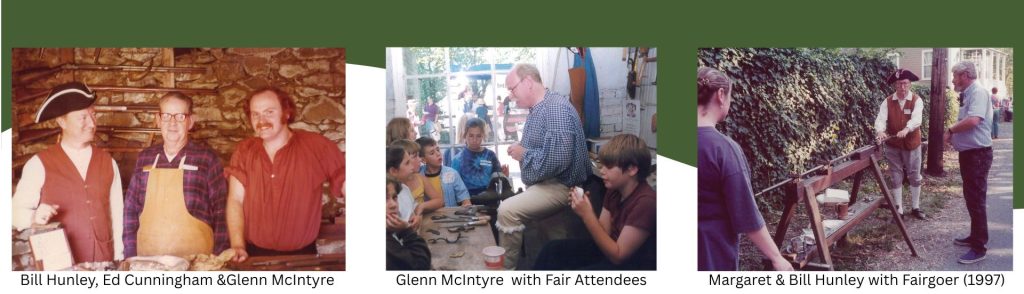
By Glenn McIntyre
Our gunsmith shop demonstrates not only how firearms were made in the 18th and
19th centuries but also their importance to the immigrant settlers of the period. Guns
and the people to repair those guns were vital to the settlement of our country.
First, guns were needed to provide food for the colonists moving into the wilderness or
what was then called the back country. There were no cleared fields so raising crops
was at least 3 or 4 years off. The only source of food was hunting.
Second, guns were needed for protection from dangerous animals and humans.
European settlers were terrified of all Native Americans because of the stories they had
heard about the “savages.” There was no understanding that there were many
different tribes, some friendly and some not so much. There were also “bad” men
throughout the colonies, thanks to the British Courts using the colonies as a dumping
ground for convicts.
The year that the village of Waterford was founded, 1733, was only 12 years after a
new treaty with the Iroquois Confederation moved the eastern boundary of Indian land
from the top of the Blue Ridge Mountains west to the Allegheny Mountains on the west
side of the Shenandoah Valley, while still allowing the Native Americans to travel
through the valley on their way north or south. A fact lost to most of the European
settlers moving into these newly opened lands, resulting in tragic attacks.
Additionally, Virginia, by the 1720’s, had militia laws requiring all white men between the
ages of 16 and 60 years old to be part of the colony’s militia and, as such, to keep a
firearm in good working order in their home.
Since most of the settlers were farmers, they also needed a firearm to protect their
crops and livestock from wild animals. Remember building fences around fields by
hand was a very difficult and time consuming job.
Finally, shooting matches were a favorite entertainment, as they still are today, and the
competition was intense.
This brings me to 1950 — the first year William (Bill) Hunley came to the Waterford Fair
to demonstrate muzzleloading firearm construction. In the late 1940’s, Bill and his
father began building “reproduction” percussion pistols. Their pistols were so good (far
better than the antique ones being used by other competitors) that the Hunlely “Boys”
took all the prizes at the 1948 and 1949 Virginia state muzzleloading pistol matches.
The “Boys” were barred from competition in 1950 — a fact that they were always very
proud of.
believe Bill came to the fair in 1950 because George Bentley (an early leader of the
fair) asked him to demonstrate.
Bill set up a table next to the store across from the present Gunsmith Shop. That first
year, not only did Bill show people how he made his pistols, but also, fair visitors were
allowed to shoot at targets set up down toward the pond. The sheep were not in the
field then.
Bill returned to demonstrate at the 1951 fair, but it rained. Again, George Bentley
helped by moving Bill’s demonstration across the street into the single room shop that
we still occupy today.
Unfortunately, the history of the shop in the 1950’s an early 1960’s was not recorded
well. I know from experience that you cannot man a shop by yourself for the three
days of the fair. I am sure that Bill’s wife, Carol, was a big help and that Bill’s father and
his brother Walter Scott helped out a lot as well.
Bill really liked the village life of Waterford — so much so that he bought some land on
Second Street and bought two 19th century log houses, disassembled them, and
moved them to his property in Waterford by the mid-1960’s About this time, Bill
became friends with Edward and Henrietta Cunningham. Ed was recently retired and
an avid muzzleloading rifle shooter, as well as a golfer and a competitive fly fisherman.
Ed helped Bill with treating the house logs for bugs and getting things designed for the
new “old” house and, of course, helped out in the Gun Shop during the fair.
I met Bill in Georgetown in the summer of 1969. He was putting on his demonstration
of hand making muzzleloading pistols. He told me about the Waterford Fair and that
he thought I might enjoy it. I came to the 1969 fair and spent the entire day in the
corner of the shop watching and listening. I was very shy, but at the end of the day, I
showed Bill and Ed the first rifle I had built. It was built from a kit, and by today’s
standards, it was not great, but Bill recognized in me a passion for the craft and the
time period. So, he invited me to help out in the shop the next year. I guess he was
right, since this year will be my 56th year working at the shop.
The three of us made a great team. Bill was a naval architect, Ed a retired lawyer, and I
filled in the history and the “how to” for doing the work by hand — including forging the
gun barrels and lock parts, casting the brass parts, decorative engraving and wood
carving. Those were the best years. Bill’s house was completed and Ed, Henrietta,
myself and my wife, Jane, all stayed with Bill and Carol during the Fair. We would cook
in the fireplaces, and other friends would come for dinner with music and stories
afterwards.
Over the years, the experiences with the visitors have left wonderful memories. The
interactions with children may have been the best of all. They are so interested and
curious. But there is one story that sticks in my mind.
I think it was about 2010 on a quiet Sunday morning. My back was to the shop door.
A woman spoke up and said that a relative had had a contract to produce pistols for
the War of 1812. I immediately asked her if her relative’s name was Simeon North.
She said yes but was very shocked that I had guessed right. She knew that the
contract was completed, but she had no idea of its importance. I was honored to
explain to her that it was the first time a contract requiring interchangeable parts had
been fulfilled. A Congressional Delegation had even investigated the contract
fulfillment (since Eli Whitney had tried to fool the Federal Government years before) and
basically said “pay the man.” To fulfill the contract, Simeon North had built the first
metal cutting milling machine — an invention that had a major impact on the industrial
revolution. She and her family were totally unaware of the significance of their relative’s
invention or of his contribution to our modern world.
She has returned twice since then — she has relatives near Waterford though she lives
in the Midwest. You just never know what or who might walk through our shop door,
and that’s what keeps me coming back.