• Skip to main content

Tickets on sale August 1st | Kids 12 and under FREE!        October 2-4, 2026 | 10am-5pm | Waterford, Virginia

Waterford Fair

81st American Crafts & Historic Homes Tour

  • 2026 Fair
    • Participate 2026
    • Demonstrating Artisans
    • Historic Homes Tour
    • Exhibits, Demonstrations & Tent Talks
    • Music & Entertainment
    • Food & Libations
  • Plan Your Visit
    • Ticket & Fair Info
    • Last Year’s Fair Map
    • Last Year’s Fair Booklet
    • Pets & Political Canvassing
  • Fair FAQS
  • Sponsorships
  • Volunteer

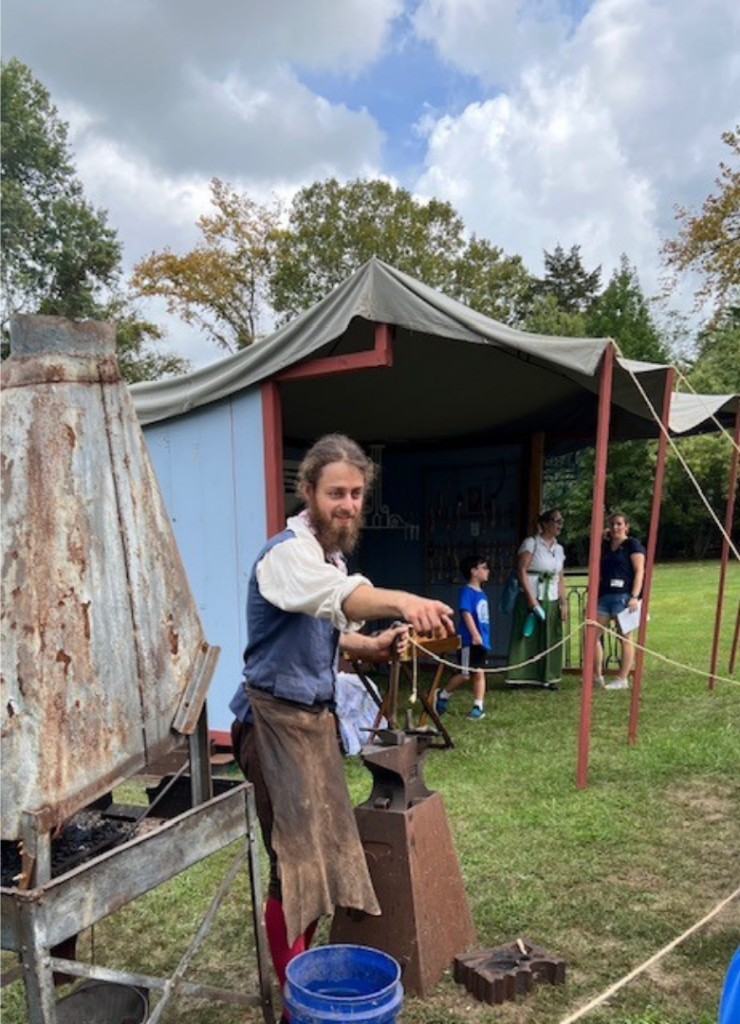
Stacy Kelly

The Doctor’s House

15523 Second Street

Open on Friday & Saturday: 10am to 5pm

Built circa 1823 by William Nettle, this three-bay, two-story residence remained in the Nettle family for over half a century, with his widow residing here until 1879. In 1898, Dr. E.H. Heaton purchased the property and added the smaller wing to the left. This addition served as a medical office for many years and was later utilized as a clock repair shop.

The Doctor’s House is open through the courtesy of the Anderson Family.

Celebrating 75 Years of the Gunsmith Shop at the Waterford Fair

For generations, the Gunsmith Shop has been one of the most popular living history demonstrations at the Waterford Fair. More than a place to see traditional craftsmanship, it offers visitors a window into the essential role firearms and gunsmiths played in early American life.

In the 18th and early 19th centuries, firearms were indispensable to settlers moving into the Virginia frontier. They provided food through hunting while farms and fields were being established, protected families and livestock from wild animals, and were relied upon for personal safety in an uncertain landscape. Virginia law also required most white men of militia age to maintain a working firearm, making skilled gunsmiths an important part of every community.

The history of Waterford itself reflects this changing frontier. Founded in 1733, the village was established during a period of westward settlement following treaties that shifted the boundaries between colonial settlements and Native lands. Like many communities of the era, Waterford grew within a complex and evolving historical landscape that shaped the daily lives of its residents.

Beyond their practical uses, firearms were also central to recreation. Competitive shooting matches were a favorite pastime throughout the colonies, attracting skilled marksmen and enthusiastic spectators alike.

A Fair Tradition Begins

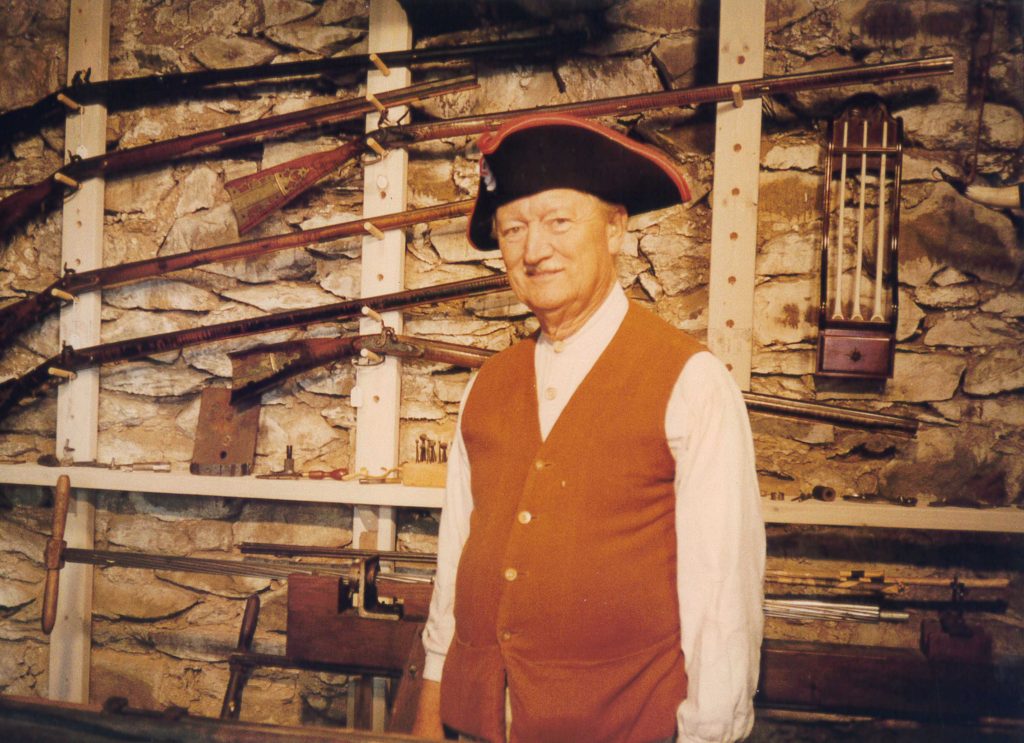
The Gunsmith Shop’s story at the Waterford Fair began in 1950, when master craftsman William “Bill” Hunley was invited by early Fair leader George Bentley to demonstrate the hand construction of muzzleloading firearms.

Bill Hunley in the Gunsmith Shop

Bill had already earned a reputation alongside his father for building exceptional reproduction percussion pistols. Their work was so accurate and well-crafted that they dominated Virginia state muzzleloading competitions in 1948 and 1949. Their success became legendary when they were barred from competing in 1950 because their handmade firearms consistently outperformed the competition.

During that first Fair, Bill demonstrated his craft outdoors near the present Gunsmith Shop, and visitors even had the opportunity to try target shooting nearby. When rain interrupted the 1951 Fair, George Bentley moved the demonstration into the small one-room building that continues to house the Gunsmith Shop today.

Although few records survive from the shop’s earliest years, it became clear that the demonstration was very much a family effort. Bill’s wife, Carol, along with his father and brother Walter Scott, helped keep the shop running throughout the Fair weekend.

A Lifetime of Craftsmanship

Bill’s connection to Waterford extended beyond the Fair. By the mid-1960s, he had purchased property in the village and painstakingly relocated two 19th-century log houses to create his home. There he formed lasting friendships with fellow craftsmen and historians, including Edward Cunningham, whose enthusiasm for muzzleloading rifles and early American history complemented Bill’s own interests.

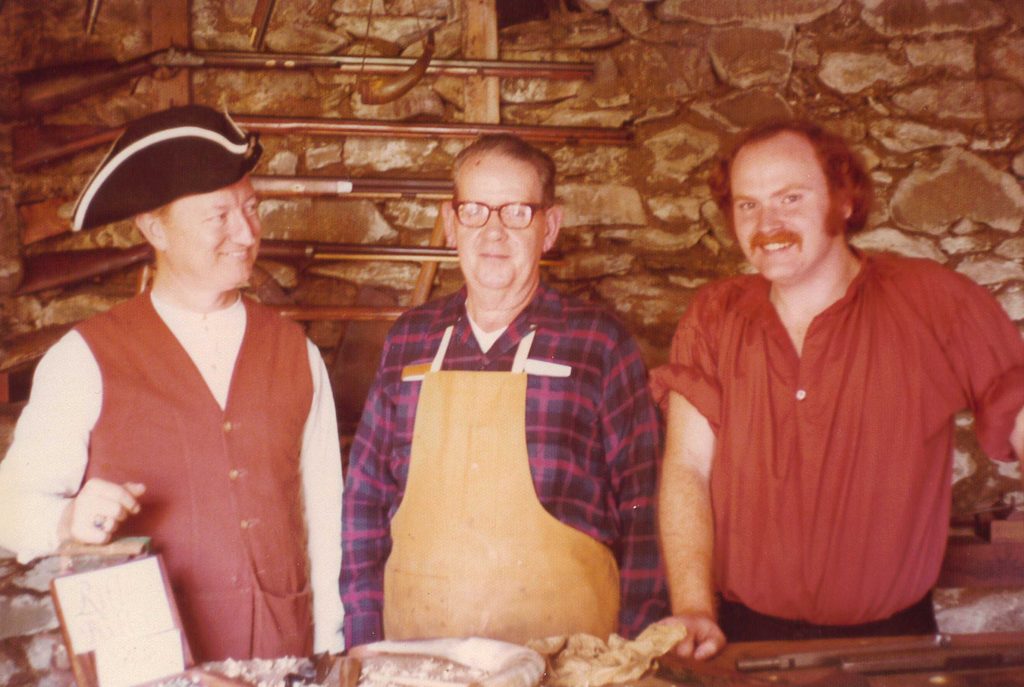
Bill Hunley, Ed Cunningham & Glenn McIntyre in the Gunsmith Shop, 1980

In the summer of 1969, another future steward of the shop, Glenn McIntyre, was introduced to Bill during a demonstration in Georgetown. Encouraged to visit the Waterford Fair, he spent the entire day observing the demonstrations before nervously sharing the first rifle he had ever built. Bill recognized both the craftsmanship and the passion behind the project and invited him to return as a demonstrator the following year.

That invitation marked the beginning of more than five decades of service. Together, Bill, Ed, and their newest teammate, Glenn, combined their talents to create demonstrations that explored every aspect of traditional gunsmithing, from forging barrels and lock parts to casting brass hardware, engraving metal, and carving wood. The Fair became more than a demonstration; it became a gathering place for friends who shared meals, music, stories, and a deep appreciation for early American craftsmanship.

Sharing History with Every Visitor

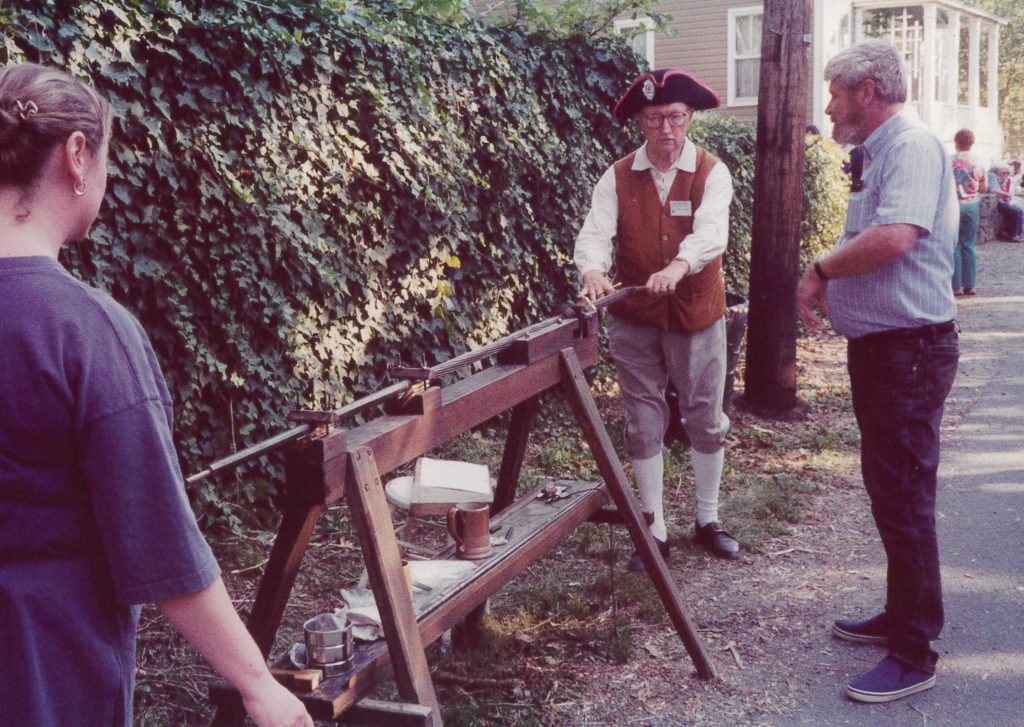
Bill & Margaret Hunley rifling the gun barrel outside the shop, 1987

While the techniques demonstrated in the Gunsmith Shop remain fascinating, the conversations with visitors have always been equally rewarding. Curious children ask thoughtful questions, amateur historians share family stories, and unexpected connections to the past emerge every year.

One especially memorable encounter occurred when a visitor mentioned that one of her ancestors had manufactured pistols during the War of 1812. That ancestor turned out to be Simeon North, whose government contract marked the first successful production of firearms with interchangeable parts. To fulfill that contract, North developed one of the earliest metal-cutting milling machines, an innovation that helped lay the foundation for modern manufacturing and the Industrial Revolution. The visitor had known of her family connection but was delighted to discover the extraordinary significance of her ancestor’s achievements.

Moments like these are what make the Gunsmith Shop so special. Every Fair brings new visitors, new conversations, and new opportunities to connect the craftsmanship of the past with the people of today.

More than 75 years after the first demonstration, the Gunsmith Shop remains a living tradition at the Waterford Fair, preserving the skills, stories, and history of early American gunsmithing for future generations.

Bunn, Chris

Chris Bunn Woodworking

Wood

I turn functional and art forms on a wood lathe using traditional tools.  I use primarily domestic wood but occasionally use responsibly harvested exotic woods.  The character and flaws/feature of the wood always dictate the final design and form of the finished piece.

I also make charcuterie boards using multiple species of woods.  Some of the designs require up to 6 to 7 hours to make a single piece.

Email

Wolford, Andrew

Woodford Woodworking Co.

Furniture

Traditional Methods
When building a piece of furniture, it all starts with a conversation and a simple sketch. From here, we source lumber from local hardwood suppliers in the Blue Ridge area. After the wood is sourced, it needs to acclimate in the shop before building begins. Every piece of furniture we build has hand-cut joinery with traditional tools such as saws and chisels. Many of these tools once belonged to my wife’s grandfather and have been passed down through generations, connecting the work done in the shop today with the traditions of craftsmen who came before.

Demonstration
We will have several biology experiments that show how wood expands and contracts from moisture; the goal is to learn about wood movement. For our tool demonstrations, we will teach how to cut mortise and tenon joints with handsaws and chisels. Visitors will also learn about drawboring joinery and see the process demonstrated. Lastly, we showcase how applying an oil finish helps slow moisture exchange and limit wood movement.

Historical Connection
Our shop uses modern tools, but our approach to building furniture is drawn from the traditions of early American craftsmen. We opt for interlocking joinery such as mortise and tenon over screws. While traditional practices provide greater structural integrity, joinery alone isn’t enough; understanding wood movement is what makes furniture last.

To build quality furniture, you not only have to understand the basic biology of wood, but also how wood interacts with its environment. Craftsmen in years past not only understood their materials, but also implemented techniques that allowed for seasonal expansion and contraction in the pieces they built. This is the precise reason why a lot of furniture from the 1800s is still passed down generations later.

woodfordwwc.com

Brown, William Francis

William Francis Brown Artisan Woodcarving

Wood

My furniture and carvings are all hand made by myself in my small shop located in the foothills of the Blue Ridge Mountains. I have been making museum quality period-inspired furniture for over 40 years. My work has encompassed carved period furniture elements such as ball and claw feet, shells, cartouches, etc,. These skills led to my carving Bellamy eagles and other iconic early American pieces over the past 10 years. My work is historically grounded and has sold to designers, architects, historic preservation sites, and customers for libraries, exterior entryways, halls, mantles, and formal interiors. I pride myself on permanence, symbolism, and the very highest quality grounded in historical authenticity. The majority of my work is oneof-a-kind and my more elaborate pieces can take months to complete. Every aspect of my carvings, from board selection to finishing is performed entirely by myself. I use traditional methods with hand tools for all of my work.

I grew up on a tree farm in Chester County, PA and served an apprenticeship in the shop of E. Townsend who was a curator at the Historic Wintertur Estate and Museum, outside Wilmington, Delaware. He was part of a two centuries long legacy of Chester County fine furniture makers. Chester County furniture developed a unique style that stemmed largely from the 17th century Welsh, English Quakers, and Dutch settlers. Certain unique design features I incorporate in my furniture includes use of line-and-berry holly inlay, paneled chests, and regional William & Mary period detail. Except for painted pine pieces, Federal inlay and veneer work, and my Windsor chairs, I rely exclusively on the abundant traditional local hardwoods: cherry, maple, and walnut. My more recent Bellamy style carvings utilize Linden and Mahogany.

My pieces have been selected for museums and historic sites, including James Madison’s Montpelior and Historic Jamestown. My work has been featured in Fine Woodworking, Popular Woodworking, and Woodwork Magazines and featured in exhibits and galleries from SanDiego, CA to Rockport, Maine. I have won numerous awards including the coveted international ‘Veneer Challenge’ in 2018. I have been selected as a ‘Top American Craftsman’ by Early American Magazine for the past 8 years and have been a featured artist. I am recognized as a leading authority on the 19th century carver, Edward Halley Bellamy, from Kittery, Maine. I use my Windsor chair tools (scorp, drawknives, adze, travisher, spokeshaves, compass plane) for the initial shaping of my carvings. Every aspect of my traditional Bellamy eagles is worked by hand from the roughing out, the finish carving, gold leaf gilding, and painting of shields, flags, and banners. My carvings have sold throughout the world to collectors and museums.

I like to scour museum archives and study originals for furniture and carving ideas, patterns, moldings, inlay designs, & proportions. I enjoy sketching details of the Chester County pieces I see in homes and exhibits in my home area. I think that with time one develops a trained eye. Craft is a combination of knowledge, skill and intuition all working together. It takes time and work to gain this, but it’s what I love.

AmericanEagleCarvings.com

Manbeck, Patricia

Tweedful Things

Fiber/Textiles

My work is rooted in early American folk traditions, particularly the visual language of PA German and Early American decorative arts.  I create hand hooked wool rugs inspired by historic fraktur, redware pottery, antique rugs, and other objects of everyday use that once carried beauty, symbolism, and meaning into ordinary life.  Working with 100% wool that I hand dye, I use a primitive rug hook and a puritan lap frame to create my art.  This medium, humble, durable, and tied to domestic labor, feels inseparable from the imagery I choose.  Birds, tulips, rabbits, and simple geometric forms appear in my work as a visual vocabulary.  These motifs historically spoke of love, faith, fertility, protection, and belonging.  I am interested in how they can still quietly speak today.  Color plays a central role in my process.  I favor palettes that feel aged and restrained-faded reds, soft ochres, walnut browns, flax, indigo, and ghosted greens-referencing 18th and 19th century dyes and the way time softens objects through use.  I intentionally avoid polish or perfection, allowing irregularity, wear, and restraint to suggest history rather than imitate it.

While my rugs are informed by museum study and historical research, they are made to be lived with.  I think of them as contemporary objects of use-functional textiles that carry forward the spirit of early American making. Through my work, I hope to honor the quiet intelligence of folk art and the enduring human desire to surround daily life with meaning.

etsy.com/shop/tweedfulthings

Cohen, Heather

Textile Design by Heather

Fiber/Textiles

I am a textile designer and artist from Zimbabwe with over three decades of design experience, currently residing in Mocksville, NC.  I hand paint with many different methods, such as Batik, Shibori, tray dying, salt and watercolor applications.  All items start out as a white blank canvas!

Design

– The Batik method is the application of melted wax, which resists dyes, resulting in the motifs and design.  The wax is then carefully removed with heat. 

– Shibori and Tray Dying is a process of folding, pleating and scrunching during dye applications. 

– All of my creations are unique and one of a kind so no two are exactly alike.  Any minor imperfections are part of all the handcrafted processes, which indicates the authenticity of this garment. 

uniqueartwear.com

Bassett, Suzanne

Suzie’s Pysanky

Mixed Media

I am a traditional egg artist specializing in Eastern European batik-decorated eggs, commonly known as pysanky. I learned this art form from my Slovak grandmother, who first placed a kistka in my hand when I was three years old. What began as a childhood activity quickly became a lifelong tradition that connects me to my family, my heritage, and the generations of artisans who came before me.

Using the wax-resist batik method, I carefully layer melted beeswax and dyes to create intricate patterns and symbolic designs on real eggshells. Each egg is built step by step, moving from light to dark colors, revealing its design only after the wax is removed at the end. The process requires patience, precision, and a deep appreciation for the cultural meanings behind the motifs.

Many of my designs draw inspiration from traditional Eastern European patterns while reflecting my own Slovak heritage and personal style. Every egg is unique and entirely hand-crafted.

At my craft table, I enjoy demonstrating the pysanky process so visitors can see how these delicate works are created. Sharing the technique, tools, and cultural stories behind the eggs is one of the most rewarding parts of my work. I love introducing people to this beautiful tradition and helping keep this historic folk art alive for future generations.

Facebook

  • Page 1
  • Page 2
  • Page 3
  • Interim pages omitted …
  • Page 7
  • Go to Next Page »

Phone: 540-882-3018
[email protected]
Waterford Old School
40222 Fairfax Street
Waterford, Virginia 20197


Copyright © 2026 · Waterford Foundation · Log in