• Skip to main content

Tickets on sale August 1st | Kids 12 and under FREE!        October 2-4, 2026 | 10am-5pm | Waterford, Virginia

Waterford Fair

81st American Crafts & Historic Homes Tour

  • 2026 Fair
    • Participate 2026
    • Demonstrating Artisans
    • Historic Homes Tour
    • Exhibits, Demonstrations & Tent Talks
    • Music & Entertainment
    • Food & Libations
  • Plan Your Visit
    • Ticket & Fair Info
    • Last Year’s Fair Map
    • Last Year’s Fair Booklet
    • Pets & Political Canvassing
  • Fair FAQS
  • Sponsorships
  • Volunteer

Uncategorized

A Brief History of Waterford

Waterford was settled in 1733 by Amos Janney, a Quaker from Bucks County, Pennsylvania. Janney was soon followed by others and Waterford became the thriving center of a community of small farms. Because the Quakers were grain farmers, a grist mill was very important to them, and the first settlement included a mill near the site of the present structure with a few houses clustered nearby. The settlement that would become Waterford grew around Janney’s Mill. From the 1760s onward, Presbyterians, Methodists and Baptists would also establish a presence here.


A few residents took part in the Revolutionary War; surprisingly, not all Quakers who saw service contrary to the Quaker principles on nonviolence were read out of Meeting. After the Revolution, Waterford grew rapidly with a wide variety of businesses, and by the 1830s, Joseph Martin’s Gazeteer wrote:


“Waterford contains 70 dwelling houses, 2 houses of public worship, 1 free for all denominations, the other a Friends’ meeting house, 6 mercantile stores, 2 free schools, 4 taverns, a manufacturing flour mill, and 1 saw, grist and plaister mill, and (in the vicinity) 2 small cotton manufactories. The mechanics are 1 tanner, 2 house joiners, 2 cabinet makers, 1 chair maker and painter, 1 boot and shoe manufacturer, 2 hatters, 1 tailor, &c. Population about 400 persons, of whom 2 are regular physicians.”


Villagers even produced Shakepeare plays for local audiences.


The Quakers were joined by Scotch-Irish craftsmen from Pennsylvania who were responsible for much of the construction of the village.


While some early residents were slaveholders, the fact that Waterford had a thriving antebellum free Black community was unusual for pre-Civil War Virginia. Waterford’s Quaker roots and the abolitionist sentiments of most Quakers may have encouraged Black settlement here.


By the time of the Civil War, most Waterfordians strongly opposed secession, a stand extremely unpopular among the majority in Loudoun County. For most of the war, the Waterford area was a no-man’s land that neither Federals nor Confederates were able to control for long. As a result of Confederate harassment, miller Samuel Means formed the Independent Loudoun Rangers, the only organized cavalry troop in Virginia to fight for the Union.


In 1871, the railroad was extended from Leesburg to Clarke’s Gap (where Routes 7 and 9 meet) thus bypassing Waterford. The philosophical isolation so obvious during the war was succeeded by a geographic isolation as commercial centers easily reached by rail took business away from Waterford. By the time of the Depression, many of the buildings had deteriorated badly. In the 1930s, brothers Edward and Leroy Chamberlin, descendants of several old Waterford families, began to restore buildings in town and, in 1943, the Waterford Foundation was formed. This provided an impetus for residents, old and new, to work to preserve the village.


Today, Waterford’s buildings and rolling fields look much as they did 200 years ago. The village is a Loudoun County Historic and Cultural Conservation District. In 1970, the entire village with the farmland surrounding it was designated a National Historic Landmark.

The Pink House

40174 Main Street

Open on Friday: 10am to 5pm

In 1825, Lewis Klein opened this building as a “house of entertainment” —a tavern.  He had purchased the lot from Quaker William Hough about 1815 for $80. Like many of its neighbors on Main Street, it was designed for mixed use—a store or other business below and a residence above.  It therefore had no interior staircase between the first and second floors until a 1950s modernization.

The present large downstairs room was built as two rooms with a central corridor; it has seen many uses over the years. After serving as a tavern the space became variously an apothecary and hardware store. In the 1880s the building was the home and office of Dr. G. E. Connell, an enterprising physician. He introduced the telephone to the village in 1884 and charged customers ten cents to call Clark’s Gap, three miles distant at the other end of the line. A side addition was used as a barbershopin the early 20th century. In the early 1950s, a new owner painted the house the color “of the setting sun on Waterford brick.”  The paint was meant to slow weathering of the soft brick; it has been repainted in other shades since.  The Pink House later was a popular bed and breakfast destination.

The present garden area has seen a succession of buildings over the past 200 years, including blacksmith and wheelwright shops and a succession of stores. A town hall and auditorium occupied the loft area of a large stable on the site. One of these shops stood where the new stone kitchen now stands. At least one of them served briefly as a residence. During an exceptionally rainy period with water pouring down the hill, a tenant joked, “I have the most modern house in Waterford— running water in every room!”

The Pink House is open through the courtesy of Isaac Johnson and Jeff Darrah.

Suerdieck, Rebecca

Perrin Cottage Perfumery

Mixed Media

Living Historian Demonstrating Natural Perfumery


Rebecca Suerdieck specializes in recreating and demonstrating traditional skills from past times.

Little by little, her research and experiments have continued, as she created a unique niche for herself: the production of all-natural fragrances from flowers. This technique was in common use by Virginia women during the 17th, 18th and 19th centuries.

She leads Garden Distilling Demonstrations and hosts workshops on Natural Perfumery, singing the praises of “floral waters” to anyone who will listen.

Rebecca is also a Living Historian and Guest Lecturer on many Subjects. She enjoys exploring the different aspects of her research with self-initiated projects.

Perrin Cottage Perfumery Website

rebeccasuerdieck.com

Fair Updates…

The 81st Waterford Fair is just a few months away! As we finalize plans for another spectacular weekend, don’t miss your chance to support this treasured event.

Many Ways to Get Involved!

  • Become a Sponsor or Donor: Support the Fair by becoming a booklet page donor or a business sponsor. Every contribution helps make the Fair possible!
  • Volunteer: Now’s the perfect time to sign up for one or more of over 400 available shifts. From guiding visitors to assisting artisans, there’s a role for everyone! Follow this link for more information.
  • Be a Homestay Host: Be a vital part of Fair history by opening your home to host a visiting artisan for the weekend. It’s a unique and rewarding experience! Complete this quick form and we will be in touch.
  • Join or Renew Your Membership: Remember the special Waterford Fair benefits for Waterford Foundation members! Join or renew now to ensure you receive your complimentary tickets and invitations to exclusive Fair events.

Member & Village Resident Tickets: Important Update!

Fair tickets are now on sale to the general public! Please share the ticket link with friends and family. Below, you’ll find important information about our new ticket process for your complimentary ticket(s).

As always, you will receive complimentary ticket(s) to this year’s event. Please note these important changes:

  • No discount code is needed this year. Tickets will be issued directly to Foundation members and village residents via email during the first week of September. They’ll be sent to the primary email address associated with your membership or household.
  • You will still need to print the e-ticket or show the ticket QR code to receive your “hanging tag” Fair ticket. You can redeem your e-ticket at the Welcome Tent or any of the three gates during Fair weekend.
  • If you do not receive your ticket email by Tuesday, September 9, please contact the office for assistance at 540-882-3018 x 0 or [email protected].

We can’t wait to see you there!

Homestay Host

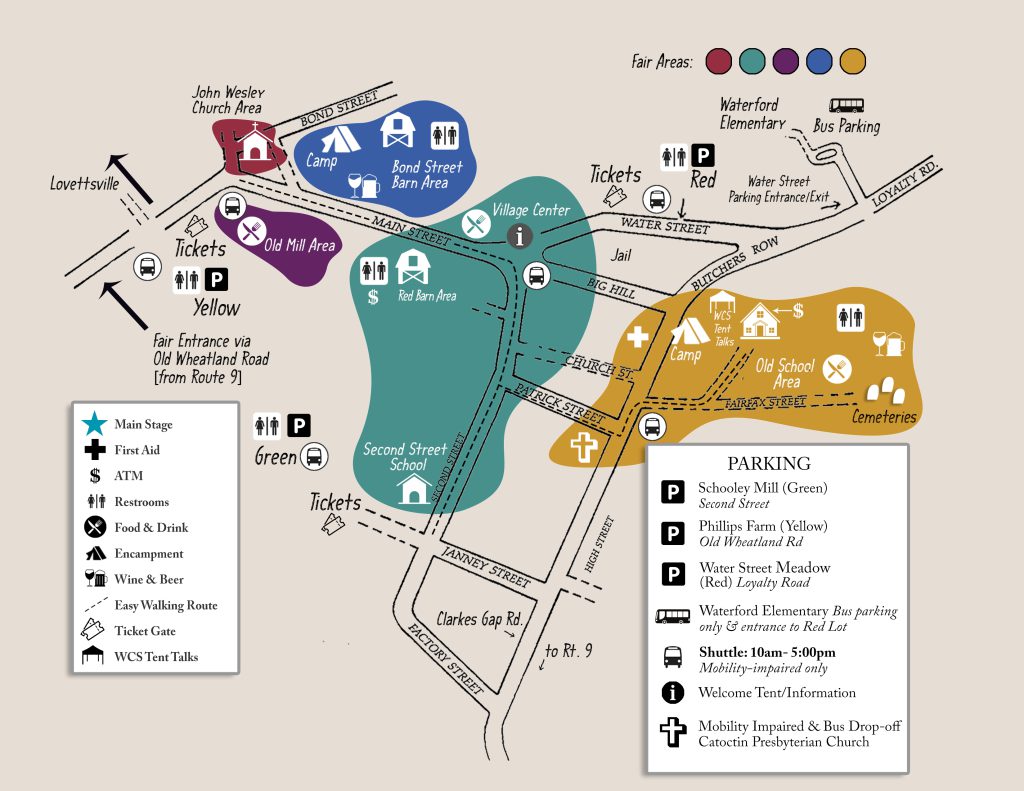
Fair Map

2024 map

2024 Fine Art Judge Eric Westbrook

We are pleased to announce that painter, illustrator, and art instructor Eric Westbrook will be judging our fine art entries this year!

Eric lives and works in the Washington DC area. His current and former teaching venues include The Yellow Barn at Glen Echo, The Smithsonian, and VisArts in Rockville, MD. He is an experienced judge of art shows and competitions. 

Eric’s landscape and portrait paintings are frequently exhibited in solo, and group shows and are held in public and private collections.

His illustrations have appeared in the publications of prominent corporate, government, and editorial clients nationwide. Eric received a Bachelor’s degree in art and design at the University of Maryland, College Park MD. His formal training in figure and portrait painting continued at the Art League School in Alexandria, VA, and the Washington Studio School in  Washington, DC. 

Eric Westbrook’s work has been described as an “art of observation”—a reference to the artist’s close observation of a subject, both for its surface details and for the structure and rhythm of its underlying forms. At the same time, the work itself repays observation: the more the viewer sits with it, the more what drew the artist to it in the first place is revealed.

His work can be viewed at ericwestbrook.com. 

Market Hill

15545 Butchers Row

The Mahlon Janney House also known as Market Hill is an exquisite example of Federal-style architecture. It was built in 1801 by Edward Dorsey for Mahlon Janney, son of Waterford’s founder. Located on Butchers Row, named for a historic slaughterhouse, this charming residence boasts 4 bedrooms, 4.5 bathrooms, and sits on just over 1/3 of an acre.

Originally, the main entrance faced Main Street atop “The Big Hill,” but later renovations moved it to its current location. The home was a medical practice for Doctor Edwards in the early 19th century and underwent significant changes in the mid-20th century, including the removal of interior partitions and the addition of a new wing.

By the early 1900s, Market Hill had fallen into disrepair until the Waterford Foundation restored and resold it. The Acheson family, who purchased the house in 1948, placed it and an adjoining lot in a conservation easement to preserve its historic integrity. In 2020, a new owner dedicated to historical preservation acquired Market Hill and has worked to restore its original beauty.

Market Hill is open through the courtesy of Camilla Strongin.

Sutherly, Julia & Dansereau, Mallory

Sycamore Spring Clothier

Fiber/Textiles

www.SycamoreSpringClothier.com

We are a proud women-owned small business, comprised of four friends who all share a deep love of the art of sewing, and the meaning to be found in studying the garments of the past. Our mission is to provide well-researched, appropriately designed, and beautifully made 18th and early 19th century clothing to individuals, historic sites, educational institutes, and businesses. 

Our expertise is in re-creating colonial North American men’s and women’s civilian clothing of the years between 1750 and 1825. Our clothing is patterned, cut, sewn, and finished in our homes using materials related as closely as possible to those found in 18th and 19th century extant period clothing. Our team focuses on finding unique fabric – vintage, when possible – made of natural fibers and in colors and prints that are representative of the time periods we are portraying. Many of our items are hand-finished, as preserving and proliferating historical, hand-sewing techniques for future generations is a keystone of our company. Our unique fabric stock, documented period construction techniques, and hand-finished details make all our pieces one of a kind.

  • « Go to Previous Page
  • Page 1
  • Page 2
  • Page 3
  • Page 4
  • Interim pages omitted …
  • Page 6
  • Go to Next Page »

Phone: 540-882-3018
[email protected]
Waterford Old School
40222 Fairfax Street
Waterford, Virginia 20197


Copyright © 2026 · Waterford Foundation · Log in