• Skip to main content

Tickets on sale August 1st | Kids 12 and under FREE!        October 2-4, 2026 | 10am-5pm | Waterford, Virginia

Waterford Fair

81st American Crafts & Historic Homes Tour

  • 2026 Fair
    • Participate 2026
    • Demonstrating Artisans
    • Music & Entertainment
  • Check Out Last Year’s Fair
    • 2025 Demonstrating Artisans
    • 2025 Historic Homes Tour
    • 2025 Exhibits, Demonstrations & Tent Talks
    • 2025 Music & Entertainment
    • 2025 Food & Libations
    • 2025 Kids Unplugged
  • Plan Your Visit
    • Ticket & Fair Info
    • Last Year’s Fair Map
    • Last Year’s Fair Booklet
    • Pets & Political Canvassing
  • Fair FAQS
  • Sponsorships

2025 Demonstrating Artisan

Jobe, Jeffrey

Barking Dog Jewelry Design Studio

Jewelry

Landmark Artisan

As a specialist in hand forged and woven/braided metal, I use a mixture of traditional silversmith, blacksmith, and goldsmith techniques and equipment to create wearable works of art with meaning, predominately through the use of a modified repousse’ technique I developed in 2002. A second technique, based upon a 15th C. technique is acid etching in sterling silver, copper, bronze, and german silver. Other techniques used include hand forged gold & sterling silver; 14K, 18K gold & sterling silver sand casting, and hand made/hand soldered bracelets & chains in sterling silver & 14K gold. I am a native of North Carolina, trained in historical archaeology, with a subspecialty in metals. I am a trained jeweler and a self taught traditional silversmith.

Most of my tools date from the 18th and 19th C. Many of the tools came from a German Jewish goldsmith who survived the Holocaust and come from the camp where he was imprisoned.

With respect to style, my knowledge base is heavily influenced by historic texts, paintings, etchings, and probate inventories while many of the techniques have been reverse engineered using methods learned as a graduate student in archaeology and museum conservation and restoration. Many of these techniques are based on hours and weeks of trial and error in an attempt to recreate lost techniques. Examples of these techniques include traditional sand casting, shot peening/burnishing, chain link construction, hand forging and folding, chasing, embossing, and metal weaving/braiding. Many of the techniques are similar to traditional blacksmith techniques, albeit slightly different. The result is a unique blend of current and historic metal smithing techniques and design.

From initial design to final polishing, all work is done by hand.

barkingdogjewelry.com

Hollenbaugh, Kelly & Gary

ThreeRingJewelry

Jewelry

Born the oldest of five into a modest family, I learned early on that to have the material things I fancied I would need to make them myself. I soon became adept at seeing a piece of clothing or an accessory and reproducing it using the materials at hand. This ability to thrift and fabricate came in useful in my early career where I not only wrote and acted but designed sets and costumes for the theatre. Later, on a whim, I took a workshop in metalsmithing, and my love of sterling silver was born.


In learning to manipulate hot metal; bending and diminishing, piercing, adding granulation, fusing, and soldering, I soon realized my uncanny talent at reproduction had found an artistic home. I love to see something that piques my interest and then figure out, first, how it is made and second, how to make it my own using mixed metals and unusual components like glass, leather, and metal clay. Often working in a series or with a particular design element, each of my creations is one of a kind. My customers enjoy choosing from the different looks that spring from the same design family. Together in our studio my husband and I produce sterling silver jewelry with pearl, gemstone, 14K gold, and bronze accents.

I am truly inspired by other jewelers, art deco architecture, and kinetic sculpture.

ThreeRingJewelry.com

Giles, Harriet

Best Demonstrating Artisan 2024

The Weavery

Fiber/Textiles

I weave rugs in a range of designs that evolve to reflect the changing tastes and moods of our society.   I adapt simple weave structures to become devices for showcasing color, enlarging the scale and using nature for color inspiration.  Because my rugs are often ordered on a custom basis, I also work with my customers’ palettes as well.  The interplay of design, color, and woven structure gives each rug its integrity and individuality.

I am moving in a direction of greater sophistication in weave structure.  Twills, Swedish Ripsmatta, and multi-harness block designs are finding their way into my repertoire.  These offer more depth, texture, and intrigue without becoming too complex visually for a large item that will be integrated into a unique interior space. 

Materials include cotton, wool, linen, and strips of cotton and wool fabric recycled from industry wastage when possible. 

theweavery.com

Carson, Joseph

Wood

Turning found wood on a lathe is an act of discovery and hope.  Each creation was originally hidden within a stick of firewood, a wormy log, or repurposed lumber.  Is it solid?  A little rotted? A lot cracked?   Can I stabilize that knot?  The will of the wood and the whim of the turner, the lucky guess and the right sharp tool reveal beauty and utility. 

Grains and colors are natural.   Highly figured woods are ‘spalted’ by the early stages of decay.    Knots, cracks and critter holes are filled with epoxy.

Bowls and utensils are finished with clear, food-safe, boiled linseed oil.   Bowls should be used for ‘dry’ foods, such as salads or whole fruit, but not for liquids.

Email

Hart, Ian

Vigilance Forge

Metal

Landmark Artisan

I graduated college in 2017 with a degree in traditionally forged ironwork under the tutelage of Richard Guthrie, a Colonial Williamsburg veteran Journeyman who moved on to teach others the craft through the American College of the Building Arts. Rick instilled in me a value of creating accurate 18th century reproductions exclusively by hand, matching the construction methods, characteristics, underlying geometry and functionality of their historic counterparts. He has since passed but I carry this lesson with me through every day: to make a profit when I can, to take a loss if I must, to sleep some nights, and others not, but always to do good work.

For several years I managed a modern architectural iron shop in Northern Virginia, designing massive custom stair railings and similar projects, from conception to construction and installation. I was surprised by the lack of care that my colleagues had in terms of craftsmanship and excellence in design, not just from coworkers but also from architects and design firms that were supposedly classically trained. The jobs were big, they were interesting, but they didn’t satisfy the quality and standards of the work that I valued. Over that period I worked part time in the evenings producing my own work, until last year, when I left the company and opened my own shop full time.

People often say “as long as it works, who cares what it looks like.” I cringe a little every time I hear this. In my experience, if it looks right, it is right, and while people may not realize it, things are distracting if care is not placed into their design and creation. While B+ work may have no fault with it, the little extra decoration, feature, or degree of quality goes a long way in transforming work from acceptable to exceptional. This is my goal today; to provide people with tools, hardware, furniture and furnishings that are a joy to look at, use, and will work as well as someone can ask, not just now, but through heavy use into the far future. Historically people relied heavily on their tools and could not afford to have them break or to replace them frequently. Because of this they are perhaps the best teachers a craftsman could look to. It is not solely with misplaced nostalgia that I look to my forefathers of the crafts, but also because I believe that we might learn lessons in how to shape our future.

VigilanceForge.com

Hall, Marian

Wooly Dye Works

Fiber/Textiles

I have been working with textiles most of my life. I started weaving in 1968, and started dyeing yarn at that time. As years went on I dappled with many other textile arts but finally settled on rug hooking as my favorite in the early 1990’s. I have now been rug hooking and dyeing wool fabric for the rugs for over 30 years. I do all kinds of hooking from fine cut to primitive cut and prefer mottled hand dyed wool to “as-is” wool to give more depth and “movement” to the colors in the rugs. Three of my rugs have been chosen for the annual Rug Hooking Magazine Celebrations book over the years and many of my rugs are featured in other rug hooking books.

WoolyDyeWorks.Etsy.com

Helberg, Kristin

Kristin Helberg Artworks

Mixed Media

Helberg has always been interested in history and a portion of her artwork reflects that.  Whaling paintings and whaling scenes on boxes, as well as sea monsters attacking ships are part of Helberg’s artwork.

She enjoys creating tavern signs that depict imaginary places in Early America.  Having spent most of her childhood in York County, PA, Helberg was immersed in the painted hex signs on barns and fraktur art and uses those images on the decorative boxes.  Years ago, she mastered the technique of Early American vinegar graining and she always features some grained boxes at the Fair.

Helberg has also  created a line of Memento Mori paintings and chests, featuring the dancing skeletons and Plaque Doctors of the late Middle Ages, as well as Halloween paintings and portraits of Edgar Allen Poe and Nosferatu.

Helberg’s paintings are in the permanent collections of The National Portrait Gallery/Smithsonian, the Clinton Presidential Library, the Reginald Lewis Museum of African American Art, Musee D’Art Naif in Quebec and the Carter Center of President Jimmy Carter.

KristinHelberg.com

Witmer, Amy & Joe

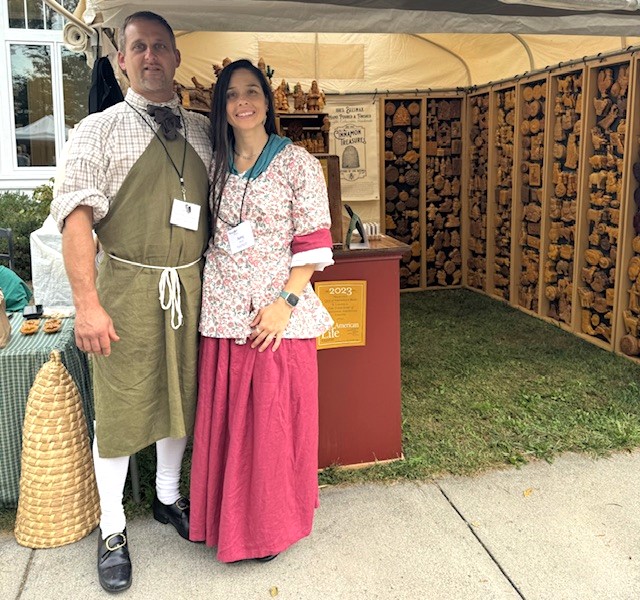
Best Demonstrating Artisan of 2023

Cinnamon Treasures

Mixed Media

Amy and Joe Witmer are passionate artisans dedicated to preserving and creating Colonial, Traditional, and Historic items by hand. They specialize in crafting solid beeswax heirloom collectible figures and ornaments using traditional German techniques of molding and carving beeswax, a skill dating back to the early 1500s. They support local apiaries and manage their own honeybee hives to ensure they use the highest quality beeswax. 

Each piece they create is unique due to the natural variations in beeswax. The Witmer’s meticulously crafted works are cherished in private collections worldwide, and they take great pride in their detailed, handcrafted pieces that merge history with craftsmanship.

Stop by their tent, just outside the Old School, to learn more about their work and art.

Our products are produced completely by hand using 100% pure and locally sourced beeswax.  We scent our beeswax using a custom blend of pure essential oil created only for Cinnamon Treasures.  We start with a solid block of beeswax, melt it down, add our scent, then we hand pour and hand finish each and every item that we sell – from scratch.  We use antique, vintage, rare, very early, and hard to find chocolate molds to pour into and create our pieces.  This makes our pieces very rare and unique because you have to acquire very early and hard to find molds.  We also pour using early flat molds, chocolate, springerle, and cookie molds to make unique ornaments.  We have a wide range of items with a large focus on Christmas and Santas, to rabbits, turkeys, chickens, pigs, horses, bee skeps and bees, hearts, cats, dogs, etc.!  It’s hard to name them all! 

Landmark Artisan

This unique art of molding and carving beeswax began in Germany centuries ago with the Lebkuchen bakers. The bakers used their Springerle and gingerbread boards to mold the first beeswax ornaments. This became a holiday tradition. These boards were carved from fruitwood into elaborate scenes of animals, birds, guild workers, country life and St. Nicholas. By the mid-1500’s, Christmas markets were thriving in German towns. There are records of bakers attending these fairs making gingerroot flavored breads, as well as merchants who made wax souvenirs which people took home and hung on their Christmas tree.It is a tradition that we carry on today. We have expanded this tradition to include casting and pouring figures from exceedingly rare and early authentic chocolate molds from makers in France and Germany as well as the US.

We have built a large following of collectors of our pieces and would love to showcase them at your artisan show.

CinnamonTreasures.com

  • « Go to Previous Page
  • Page 1
  • Page 2
  • Page 3
  • Page 4
  • Page 5
  • Page 6
  • Interim pages omitted …
  • Page 9
  • Go to Next Page »

Phone: 540-882-3018
[email protected]
Waterford Old School
40222 Fairfax Street
Waterford, Virginia 20197


Copyright © 2026 · Waterford Foundation · Log in